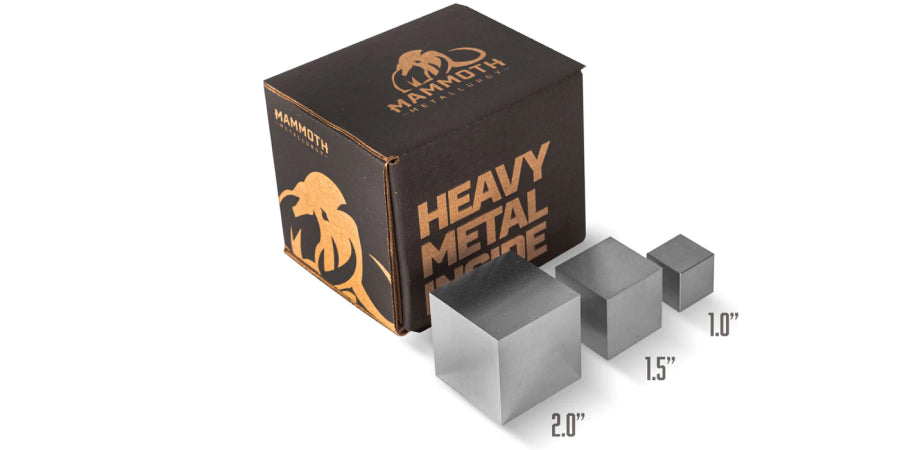





If you've ever held one of our tungsten spheres or cubes near a magnet, you may have noticed something curious: a faint, subtle pull. Not the snap of a steel ball bearing locking onto a fridge magnet, more of a whisper. Just enough to make you wonder.
It's a question we've been getting more often, so we wanted to clear it up: yes, that slight magnetic response is real, and no, it's not a defect. It's actually a fingerprint of how high-density tungsten products are made.
Pure Tungsten Isn't Magnetic
Let's start with the basics. Tungsten in its pure form is paramagnetic, which is the scientific way of saying it has essentially no meaningful response to a magnet. If you could hold a chunk of 100% pure tungsten next to a neodymium magnet, you'd feel nothing.
So where does the pull come from?
The Role of the Binder
Pure tungsten powder, on its own, is incredibly difficult to form into solid, dense shapes. It has one of the highest melting points of any metal on earth (over 6,100°F), which makes traditional casting nearly impossible at any practical scale.
To turn tungsten powder into the dense, polished spheres and cubes you hold in your hand, manufacturers use a process called liquid phase sintering. The tungsten is mixed with a small amount of a binder metal, in our case a blend of nickel and iron, and then pressed and heated until the binder melts and locks the tungsten particles together into a solid, machinable piece.
Our tungsten alloy is roughly 95% tungsten and 5% nickel-iron (NiFe) binder. That composition is what gives our products their incredible density (around 18 g/cm³, nearly 70% denser than lead) while still allowing them to be machined, polished, and finished to the quality you expect.
Why You Feel a Pull
Here's where the magnetism comes in. Both nickel and iron are ferromagnetic. They're the materials that magnets actually stick to. Even though they only make up about 5% of the alloy, that small amount of NiFe binder is enough to produce a very slight magnetic response when you bring a strong magnet near the finished piece.
It's a fraction of what you'd feel from a piece of steel, but it's not zero. Think of it as a side effect of using the most practical, highest-quality manufacturing process available for high-density tungsten alloys.
The Tradeoff Is Worth It
Could we make a tungsten product that's completely non-magnetic? Technically yes. There are tungsten alloys that use copper-based binders instead of NiFe, which would eliminate the magnetic response. But there are reasons most premium tungsten manufacturers (us included) stick with the NiFe formulation:
- Higher density. NiFe-bound tungsten typically achieves better density than copper-bound alternatives, which matters when you're paying for a product whose entire appeal is heft.
- Better machinability and finish. The NiFe binder produces a more uniform microstructure, which translates to a cleaner polish and a more consistent feel in hand.
- Greater durability. NiFe-bound tungsten alloys tend to hold up better to handling, drops, and long-term use.
For an EDC piece, a desk object, a counterweight, or a collector's curiosity, those tradeoffs are easy. The slight magnetic response is a small acknowledgment of what makes the piece dense, durable, and beautiful in the first place.
Bottom Line
If your Mammoth Metallurgy tungsten sphere or cube shows a faint magnetic pull, that's the NiFe binder doing its job. It's not a flaw, it's not a sign of contamination, and it doesn't mean you got a different product than what's listed. It's the natural result of how a 95/5 tungsten alloy is made, and it's part of why the piece in your hand has the density, finish, and presence that pure tungsten alone could never deliver.
Got more questions about how our tungsten products are made? Drop us a line. We love nerding out about this stuff.